Mushroom Powder vs. Extract: What Processing Terms Mean
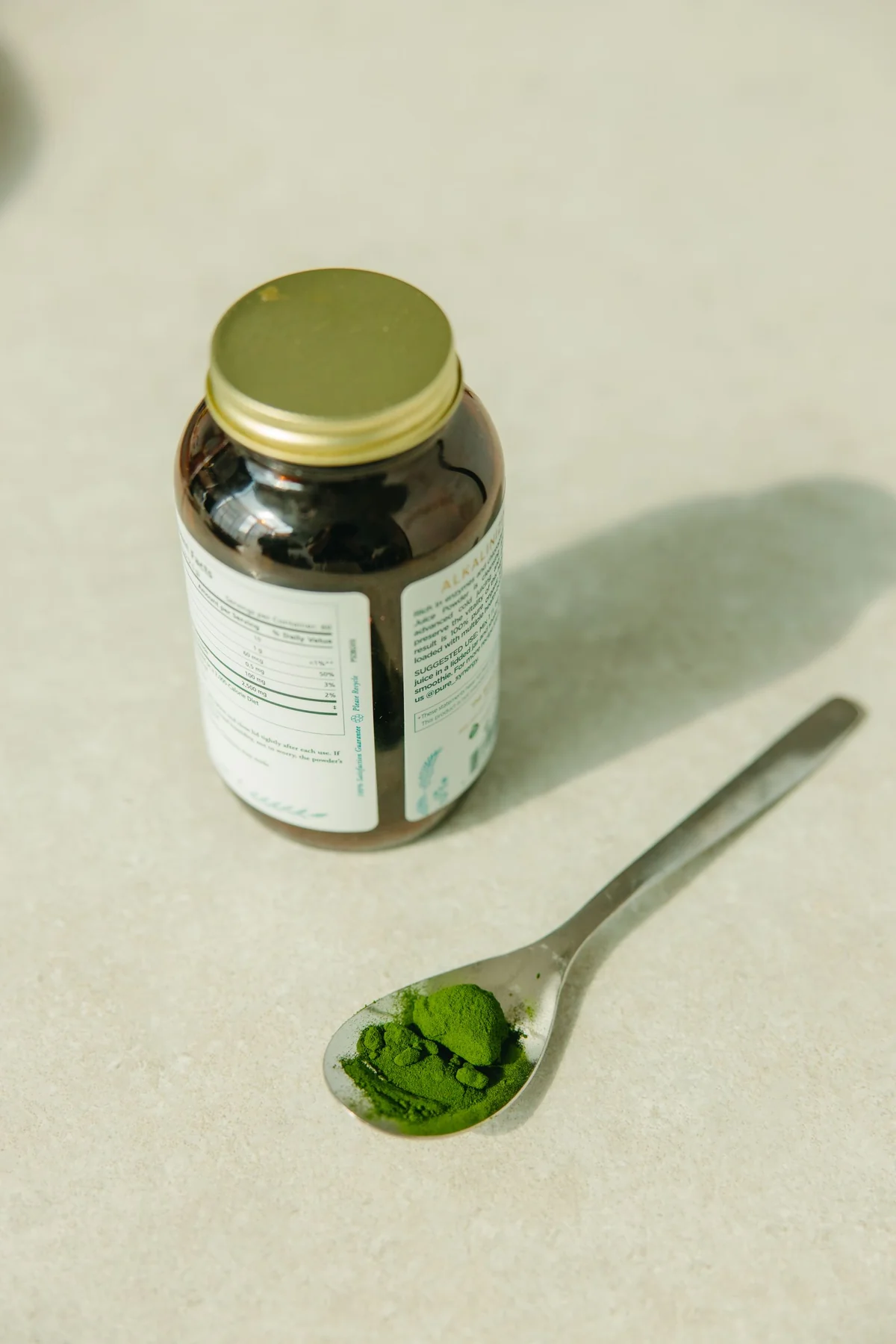
“Powder” and “extract” describe different ingredient forms, but neither word alone tells you what a finished coffee contains. This guide explains the questions behind those terms: what was processed, what was used to extract it, how an amount is stated, and what a consumer still cannot conclude from a product label.
A whole-material powder starts with dried biomass
A whole-material mushroom powder is generally made by drying and milling mushroom material into smaller particles. The source could be a fruiting body, mycelium, or another described biomass. The label should be read for that starting material because “mushroom powder” does not identify the species, the part, the growing substrate, or whether the ingredient was extracted before it was dried.
Powder can be used as a food ingredient or as one component in a blend. It may disperse, settle, or leave a texture that differs from a soluble coffee base. That visible behavior is not a laboratory analysis of its composition. Consumers should use the package directions and avoid assuming that a spoonful of one powder is equivalent to the same volume of another product.
Extraction and ratios describe different process details
Extraction uses a process to move selected constituents from source material into a liquid or other medium, then collect the resulting extract. Water and alcohol are examples of solvents used in some mushroom research and manufacturing. The method chosen affects which substances are recovered, but the word “extract” without details does not tell a shopper which compounds are present or in what amount.
Some extracts are dried into powder for blending. Others remain liquid or are standardized to a stated marker. A finished powder labeled as an extract may therefore look similar to a milled whole mushroom while having a different processing history. Ask what the ratio means, which material was extracted, and whether the finished ingredient has a quantitative specification.
A ratio such as 5:1 or 10:1 is often used to describe the relationship between starting material and a resulting extract. Without a defined calculation and manufacturing context, the number can be hard to interpret. It should not be read automatically as a potency score, a dose equivalence, or proof that one product is stronger than another.
To compare ratios, a consumer would need consistent information about the starting dry material, the extraction yield, any carriers or excipients, and how the company reports the ingredient. If the package provides none of that, the ratio is only a partial descriptor. Do not use it to calculate the amount of an active compound unless the manufacturer provides a separate validated measurement.
Different compounds behave differently in processing
Mushrooms contain a range of compounds with different physical and chemical properties. Reviews of fungal polysaccharides describe multiple extraction approaches and note that the recovered mixture depends on source material and conditions. This is a reason to ask about method and measurement, not a reason to assume that a more complicated process necessarily produces a better drink.
A laboratory paper may focus on one fraction or one assay. Its result applies to the sample and method reported in that paper. A commercial blend may use a different species, starting material, extraction solvent, or amount. Translating laboratory values into product claims requires matching those details; a generic ingredient name does not complete that bridge.
What to look for on the package
Read the whole ingredient list, not just a front label. Note the species, the named part or biomass, whether the ingredient is described as a powder or extract, the per-serving amount, and any stated carrier. If a proprietary blend gives only a combined amount, it does not reveal each mushroom's individual contribution unless the manufacturer separately discloses it.
Check whether a standardized marker is named and whether the quantity is presented per serving. A phrase such as “standardized” should invite a follow-up question: standardized to which constituent, measured by what method, and based on which batch? If no answer is available, record the detail as undisclosed. A label is not a substitute for a batch-specific analytical report.
What processing terms cannot establish
Powder, extract, dual extract, and ratio are descriptions of form or process. They do not on their own establish the identity of a species, the absence of contaminants, consistency across batches, a clinically effective dose, or a health result. Those questions call for different kinds of evidence, such as identity testing, contaminant analysis, manufacturing records, or a controlled study of the finished product.
The regulatory category also matters. A mushroom coffee sold as a conventional food is not automatically governed by the same label format as a dietary supplement. Do not apply a supplement label rule to every beverage without checking how that product is classified and marketed. For a shopper, the simplest next step is to ask the manufacturer for the exact current package and the meaning of any technical terms it uses.
A useful comparison note
When comparing two products, make a row for each: species, fungal part, whole powder or extract, amount per serving, ratio definition, carrier ingredients, and any batch testing. Mark missing information as “not stated.” This makes the comparison honest and reduces the temptation to rank a product from one impressive-sounding number.
If your goal is to understand the current RYZE formula, begin with its live ingredient statement and note when you checked it. Formulas and labels can change. A historical package, a seller's summary, or an ingredient study may help explain terminology but cannot replace the label attached to the product you are evaluating.